
Auction Sheet Translation - Basics
- Why you must have quality car auction sheet translation?
- How to read Japanese car auction sheets?
- How to understand car auction sheet indicators, comments and check marks in Japanese?
Auction Sheet Translation - Structure
The standard auction sheet translation helps you verify general car condition, even without Japanese skills. The Japan used car auctions sheets combine 5 main check points.Auction Sheet Translation - General Exterior Grade
- Car exterior paint and panel inspection marks such as: paint fade, blemishes, dents, scratches and cracked areas
- Interior Grade and Options description: salon and equipment functionality description. Worn out degree, dashboard and ceiling deformation, stains, torn or cut areas, holes, interior lining etc.
- Lists the available inside electronic equipment
- Vehicle detailed parameters: lists vehicle standard registration and technical specifications: year, model, maker, engine size, seats count, engine displacement, fuel type and transmission
- Inspectors caution marks : a must know area for mechanical, technical issues such as leak, noise, fixing and missing parts
The online auction sheet structure summarizes main indicators and their explanations. For more details on car auction sheet translation please contact us.
Order auction sheet translation from our online auto auction system with a single click.Auction list
Please point and click at any part of the interactive auction sheet template, to find the indicators and their explanations.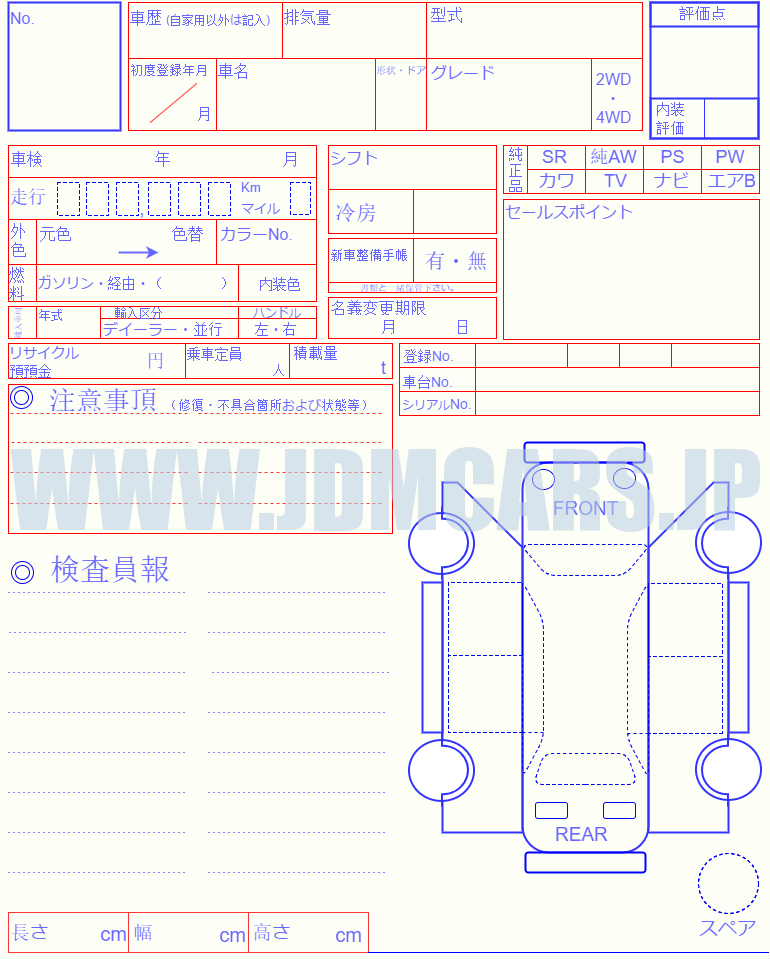
Lot Number
All Japanese Auto Auctions use similar system of vehicle identification. A unique lot number for each vehicle, for example USS TOKYO 10001.
Ownership History
Indicates the type of vehicle ownership such as private, rental or business use.
Engine Capacity
Engine capacity (cc). CC stands for cubic centimeters-a unit of volume. Please pay attention, when estimating import duties.
Vehicle Model
Shows manufacturer distinct identification. The chassis/bodywork combination with variations in several engine capacities, transmission types, braking, steering systems and interior equipment.
Overall Evaluation by Grade
S GRADE
Brand new car condition with manufacturers guarantee
6 GRADE
Excellent condition, close to brand new
5 GRADE
Very good condition, minor cosmetic work
4.5 GRADE
Quite reliable condition
4 GRADE
Good condition, year corresponding grade
3.5 GRADE
Average condition, some work needed
3 GRADE
Below average condition
2 GRADE
Very bad condition, major restoration needed
1 GRADE
Salvage, not running condition
R/RA/0 GRADES
Restored vehicles
Japanese First Registration Date
Unlike other countries, in Japan the registration year indicates how old is the car. Important to know that registration year is not the same as manufacture date.
Model name
The brand name of the Auto Maker / Toyota, Nissan, Honda, BMW, etc/
Doors
A door count is indicated as 2/3/4/5, for some models a rear trunk is considered as door.
Model Version
The model version - is a technical term for the model specification based on the engine, electronics, additional equipment or chassis variations.
Drivetrain
Two-wheel drive, four-wheel drive and all-wheel drive forms of drivetrain are indicated.
Interior Grade
A GRADE – Clean, no cracks or missing parts
B GRADE – Minor restoration needed
C GRADE – Below average condition
D GRADE – Requires restoration
E GRADE – Complete restoration needed
Japan Motor-vehicle inspection
Japanese automobile inspection system to ensure that vehicle is properly maintained. All cars driven in Japan must have a shaken to be driven on public roads.
Odometer (mileage) record
The odometer reading of the car with indication of odometer replacement or tempered mileage.
Exterior and Interior Color
Car Exterior Color is indicated to confirm whether it is original, color changed or same-color paint. Manufacturers color code is indicated.
Fuel Type
Specific vehicles fuel type: gasoline, diesel, gas, hybrid and electric.
Imported Vehicle
A foreign made vehicles section with import type such as dealer or private import, steering wheel location- Left Hand Drive (LHD)/Right Hand drive (RHD).
Transmission type
AT, FA, FAT, IAT, CA, CAT, CVT, ICVT- Automatic transmissions
MT, F5, 5C, 5SPD/6F/6 – Manual transmission
Air Conditioner Type
Availability and type of installed air conditioning system: AC, AAC, WAC.
Maintenance
Vehicles maintenance record history and de-registration period.
Factory Original Equipment
Equipment installed originally by manufacturer:
• AAC /AC/WAC – Air conditioning
• AB, SRS, WAB – Airbag types
• NAVI, GPS – Navigation system
• PS – Power steering
• PW – Power window
• SR – Sunroof
Sales Points
An additional information indicated by the seller to attract bidders' attention. Usual sales points are: 1 owner, optional features, expensive aftermarket equipment.
Disposal fee
All Japanese cars come with disposal fees, also called recycle fees. The fee depends on the manufacture year, engine capacity and gross weight.
Passenger Number and Loading Capacity Limit
Maximum number of passengers allowed (left box). Maximum Loading Capacity for vans, trucks, pick-ups (right box).
Chassis number
Vehicles unique chassis/vin number is indicated. Please pay attention that some cars due to theft history or corrosion have chassis number changed.
Extra information
In this section an additional description is provided by seller or auction personnel. Might include Positive or negative information on repair history, equipment functioning.
Chassis Chart
A vehicle body chart used to indicate exact defects location. Each kind of damage indicators are graded by severity rating 1-4.
Defect indicators:
A - Scratch, B- Bend dent, C- Corrosion,
E- Dimple, G- Stone chip, H-Paint blemishes,
S- RUST, U -DENT, W- Wavy areas,
Y - Crack, P -Paint faded, X- Structural damage
Independent Inspector's notes
Summarizing evaluation notes that describe mechanical, electric, structural, interior and exterior conditions. This the most important part to check.
Vehicle Dimension
Description of car dimensions: height, width and length. The information must correspond to vehicle registration documents.